
Jazz, a genre steeped in history and emotion, has been shaped by countless artists. Each musician contributes their unique style, leaving a lasting impression on the musical landscape. From the soulful notes of saxophones to the intricate interplay of piano keys, jazz exemplifies creativity and resilience.
1. Thelonious Monk: The Genius of Modern Music, Vol. 1
Thelonious Monk's "The Genius of Modern Music, Vol. 1" stands as a significant milestone in jazz history. Released in 1947, this album showcases Monk's innovative spirit and distinctive style, combining intricate rhythms with unconventional melodies. Monk captivated listeners with his ability to create music that was both angular and accessible. His sharp, percussive approach challenged and expanded jazz's boundaries, prompting audiences to reconsider their understanding of harmony and improvisation.
This album features tracks that embody Monk's genius. Pieces like "Round Midnight" and "Ruby, My Dear" highlight his talent for crafting beautiful melodies, intertwined with elaborate chord progressions. Each track offers an exploration, with Monk guiding listeners through unexpected musical pathways.
Monk introduced a new vocabulary to jazz with this album, appealing to both intellect and emotion. His work here transcends time, continually inspiring musicians to experiment and push the limits of jazz. The enduring nature of "The Genius of Modern Music, Vol. 1" lies not just in the music itself, but in how it reflects the bold shift occurring in jazz during the 1940s—an era marked by innovation and the pursuit of novel expression.
Monk's influence is undeniable; his music on this album inspired countless artists who found courage in his approach. The album's timeless quality stems from its ability to resonate with each new generation, demonstrating that true genius leaves an enduring impact.

2. Django Reinhardt: Rétrospective 1934-53
Django Reinhardt's "Rétrospective 1934-53" celebrates a groundbreaking artist who overcame adversity to redefine jazz guitar. After a tragic injury that left him with only two functional fingers on his left hand, Reinhardt developed a style so unique and masterful that it would echo through the ages. This collection captures his journey, brimming with fiery runs and soulful melodies.
Reinhardt's retrospective exemplifies his genius, showcasing his ability to merge traditional Gypsy sounds with the emerging jazz movement of the time. Tracks like "Nuages" and "Minor Swing" emphasize his remarkable technique—each note brims with emotion, as if his guitar is recounting a tale all its own. His music alternates between intricate solos and fluid rhythms, reflecting his deep connection to both his cultural roots and the jazz genre.
Despite physical limitations, Reinhardt's playing was anything but restricted. His two-fingered fretting produced a sound that was both technically impressive and emotionally rich. His influence extends beyond the jazz world, inspiring guitarists across multiple genres to think outside traditional constraints.
This retrospective is more than a collection of tracks; it's an experience. Each piece invites listeners to a world where creativity triumphs over adversity, proving that true artistry knows no bounds. Reinhardt's ability to overcome his circumstances and create music that continues to inspire is a tribute to the timeless nature of his genius.
Reinhardt's legacy, immortalized in this collection, reminds us of music's transformative power. His journey from a small French village to international acclaim is an inspiring tale of determination and innovation. His sound remains as vibrant and compelling today as it was in the 1940s—a testament to the enduring appeal of his pioneering Gypsy jazz.
3. Coleman Hawkins: Body and Soul
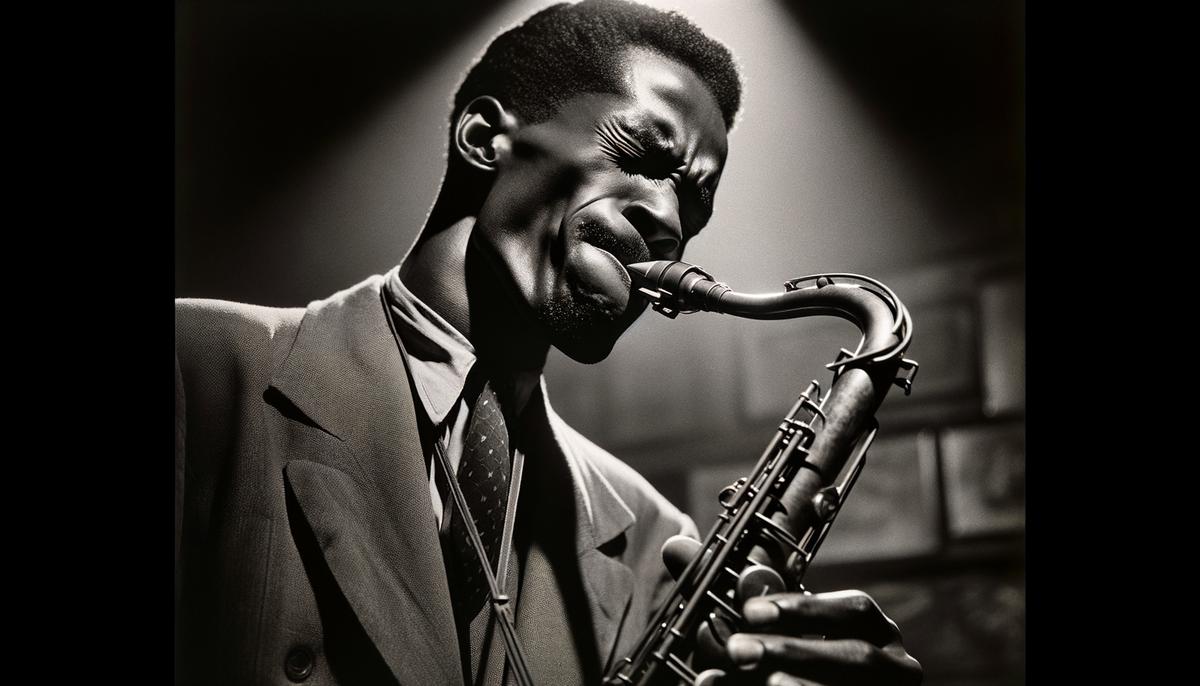
Coleman Hawkins' iconic rendition of "Body and Soul" is a defining moment in the history of the tenor saxophone. In 1939, Hawkins took a simple melody and transformed it into an intricate composition of sound through his striking improvisational prowess. This performance elevated the tenor sax from an accompaniment role to a leading voice in jazz.
What distinguishes Hawkins' "Body and Soul" is his inventive approach—each note seems to breathe life and emotion, capturing a depth that feels as fresh today as it did then. It was Hawkins' ability to subvert expectations, weaving a solo that felt both timeless and ahead of its time, which paved the way for future saxophonists. His bold improvisations challenged and inspired the jazz community, proving that even familiar tunes could be turned into something groundbreaking.
Hawkins' rendition is a masterclass in balance, merging technical skill with emotional expression. Listening to his sax solo is like experiencing a dialogue with the soul of jazz itself, layered with unexpected modulations and lyrical phrasing that tell a story without words. Each phrase seems to glide effortlessly into the next, as Hawkins unravels the song in a way that remains unmatched.
The legacy of Coleman Hawkins' "Body and Soul" echoes through generations, influencing countless musicians who have sought to capture a fraction of his mastery. He did not just play notes; he injected them with life and individuality that earned him a lasting place among jazz greats. What makes this particular recording truly timeless is its ability to continuously connect with listeners, offering something new with each listen. Through Hawkins, the tenor sax became an instrument of expression and emotion, proving the power of innovation in preserving music's eternal allure.
4. Art Tatum: The Genius of Art Tatum No.1
Art Tatum's album, "The Genius of Art Tatum No.1," exemplifies musicianship that continues to astonish listeners with its virtuosity and imaginative interpretations. Released in 1953, this collection cements Tatum's legacy as an icon in jazz history.
Tatum's piano skills are often described as otherworldly, a fitting tribute for someone who could perform keyboard feats that still seem impossible. His fingers dance over the keys with lightning-fast precision, producing harmonies so intricate they could easily bewilder even the most accomplished musicians. Each piece he touches transforms into a rich composition of sound, woven with textures that seem both spontaneous and carefully crafted.
"The Genius of Art Tatum No.1" highlights his ability to reinterpret jazz standards with an inventiveness that breathes new life into familiar tunes. Listening to Tatum is like stepping into a vibrant sonic landscape, where every note brims with emotion and technical prowess. His renditions of classics such as "Tiger Rag" leave audiences spellbound, as if witnessing something extraordinary.
The intricacy of Tatum's harmonies and his daring use of improvisation challenged the conventions of his time, urging jazz pianists to expand their own boundaries and explore new areas of creativity. His influence has resonated through jazz for decades, inspiring generations of musicians who aspire to reach even a fraction of his genius.
What truly makes "The Genius of Art Tatum No.1" timeless is its universal appeal, transcending genre limits to captivate listeners from all walks of life. Tatum's artistry reminds us that music, at its core, is about connection—creating a bridge between emotion and expression. His work on this album stands as a beacon of innovation, showcasing how virtuosity and imagination can spark magic that endures through time.

5. Charlie Parker: Ko Ko
Charlie Parker's "Ko Ko" altered the course of jazz forever. Recorded in 1945, this track showcases Parker's dazzling virtuosity and pioneering brilliance, embodying the essence of bebop with frenetic energy and lightning-fast tempos. Listening to "Ko Ko" is like experiencing a whirlwind of sound, where Parker's alto saxophone guides you through a maze of sophisticated harmonies and intricate rhythms.
"Ko Ko" stands out not only for its intensity but also for Parker's uncompromising artistry. His ability to handle such a challenging piece with ease was nothing short of astounding. Each note in "Ko Ko" feels like a spark, igniting a fire of creativity that pushed jazz into uncharted territories. It's as if Parker was having a conversation with music itself, challenging it, coaxing it, and ultimately bending it to his will.
Parker's impact on jazz was monumental. He didn't merely play; he redefined what jazz could be, paving the way for future generations to innovate and explore. "Ko Ko" shattered norms and inspired countless musicians to break free from traditional boundaries, urging them to embrace improvisation and complexity with boldness.
The track's relentless pace and harmonic sophistication continue to captivate modern listeners, proving that Parker's genius transcends time. With "Ko Ko," Parker not only carved out a new path for jazz but also planted the seeds for an entire movement that celebrated freedom and ingenuity. His legacy endures, inspiring musicians to pursue their own artistic revolutions, forever cementing "Ko Ko" as a timeless pillar in the storied history of jazz.
6. Sarah Vaughan: Sarah Vaughan
Sarah Vaughan's self-titled debut album, released under the EmArcy label, exemplifies vocal jazz at its finest. Known affectionately as "Sassy" or "The Divine One," Vaughan's monumental entrance into the jazz scene redefined the standards for vocalists everywhere. With a voice as smooth as silk and as powerful as a tempest, her debut collection showcases the impressive range and emotive depth that set her apart in the crowded musical landscape of the 1940s and beyond.
Each track on the album demonstrates Vaughan's extraordinary talent and versatility. Her impeccable phrasing breathes new life into every word, transforming standard melodies into profound statements of emotion and artistry. Listening to her interpretations of tunes like "Lullaby of Birdland" and "April in Paris" is akin to taking a melodic journey, one where Vaughan's voice is both guide and destination.
What makes Vaughan's debut truly timeless is not just her impressive range, but also her ability to infuse each note with profound emotion. She sings not just from the lungs, but from the very depths of her soul, touching on joy, sorrow, and everything in between with an authenticity that resonates powerfully with her audience. Her creative interpretations challenged the boundaries of jazz vocals and opened new avenues for expression in the genre.
In a world dominated by instrumentalists, Vaughan's voice stood out as an instrument in itself, inspiring generations of singers across various genres. She effortlessly fused jazz with elements of pop and classical music, creating a sound that was uniquely her own and delightfully indiscriminate of musical boundaries. Her ability to cross these stylistic barriers with elegance and confidence started a ripple effect, influencing artists from Ella Fitzgerald to modern-day legends like Aretha Franklin and Whitney Houston.
Sarah Vaughan's debut is more than an album; it is a bold declaration of her place in jazz history. Each track remains as vibrant today as it was upon its release, echoing the depth and vitality of a bygone era and affirming Vaughan's status as one of the greatest vocalists to ever grace the stage. Her legacy endures, offering inspiration and insight to aspiring singers and avid music lovers alike, reminding us that true artistry transcends time and continues to resonate long after the final note has been sung.

7. Charlie Haden: Liberation Music Orchestra
Charlie Haden's "Liberation Music Orchestra" stands as a bold testament to music as a tool for political expression. Released in 1969, this album masterfully blends avant-garde jazz techniques with folk traditions, drawing inspiration from the Spanish Civil War and leftist movements.
Haden assembled a diverse ensemble, creating a soundscape that's both stirring and thought-provoking. Tracks like "Song for Che" and "The Introduction" showcase a fusion of:
- Mournful refrains
- Complex harmonic explorations
- Political undertones
The album transcends traditional jazz norms, incorporating:
- Flamenco echoes
- Folk tunes
- Avant-garde dissonance
This rich auditory experience invites listeners to reflect on the political landscape of the 1960s and the ongoing struggle for justice and human rights.
Haden's collaboration with arranger Carla Bley resulted in a suite that feels both epic and intimate. His willingness to blur genre lines and embrace eclectic influences paved the way for future generations of musicians to use jazz as a platform for social commentary.
"Liberation Music Orchestra" redefines the boundaries of jazz and reaffirms its place as a transformative force within cultural history.
The enduring power of this album lies in its ability to capture the spirit of resistance and the quest for freedom. It's a reminder that jazz, like the human spirit, thrives on innovation and the courage to defy conventions.
8. Lester Young/Buddy Rich Trio
The collaboration between Lester Young and Buddy Rich in the "Lester Young/Buddy Rich Trio" recordings exemplifies jazz's dynamic and conversational nature. Young's fluid tenor saxophone voice met Rich's unparalleled drumming prowess to create a groundbreaking musical dialogue.
Their recordings reveal:
- A seamless exchange of ideas
- Masterful improvisation
- Musical connectivity at its finest
Young's smooth, lyrical tone provides the perfect counterpoint to Rich's vibrant rhythms. Their mutual respect and intuitive understanding allowed for a cohesive yet spontaneously inventive sound.
Young explores melodic themes with gentle confidence, while Rich creates intricate patterns of rhythm, elevating the concept of conversational jazz. The trio's recordings, featuring nuanced solos and surprising dynamic shifts, demonstrate how music can be both structured and free-flowing.
The chemistry between Young, Rich, and the piano accompaniment resulted in a timeless collection that:
- Solidified Young's status as a tenor saxophone luminary
- Showcased Rich's rhythmic genius
- Demonstrated the collective brilliance of jazz as an art form
Their work continues to inspire, reminding listeners of the magic that can unfold when exceptional talents come together in the spirit of musical exploration and innovation.

The enduring power of jazz lies in its ability to connect across generations. These artists remind us that music transcends time and continues to inspire with each note played. As we reflect on these influential recordings, we're reminded of jazz's unique capacity to capture the human experience in all its complexity and beauty.