
Defining Film Noir
Film noir emerged during the 1940s as a distinctive style capturing post-war disillusionment and societal anxiety. It wasn’t a genre but more of a mood, characterized by shadowy visuals and morally ambiguous characters.
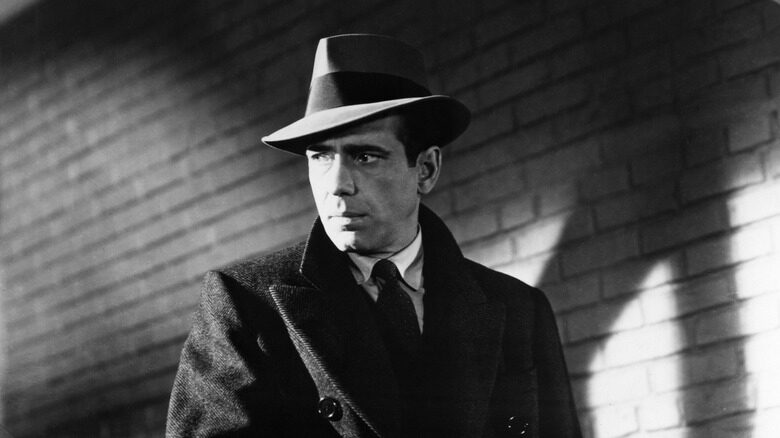
Directors used sharp contrasts between light and shadow, creating an atmosphere of lurking danger. Low-key lighting cast long shadows, rebelling against the polished visuals of mainstream cinema.
Characters in film noir are often morally ambiguous heroes dragged into trouble by their own weaknesses. The hard-boiled detective, like Humphrey Bogart’s Sam Spade in “The Maltese Falcon,” embodies cynicism with a personal code of ethics. The femme fatale, dangerous and alluring, leads men into treacherous situations. Jane Greer’s Kathie Moffat in “Out of the Past” is a prime example.
Noir themes revolve around moral complexities, broken dreams, and shifting loyalties. “Double Indemnity” showcases how the promise of love can lead to betrayal and murder. Hitchcock’s “Strangers on a Train” explores the randomness of fate, while Orson Welles’s “Touch of Evil” delves into greed and corruption.
As time passed, noir evolved into neo-noir, updating its aesthetic for modern audiences. “Blade Runner” took noir’s dimly lit cityscapes and added a futuristic twist while maintaining the core of existential doubt.
Film noir remains a captivating piece of cinematic history, inspiring and enthralling with its exploration of life’s moral and emotional dilemmas.

Iconic Film Noir Characters
Film noir characters breathe life into the shadows, often standing at the crossroads of right and wrong. The protagonist – a detective, drifter, or everyman caught in the wrong place – serves as a reflection of a society wrestling with its conscience. Their struggles are both external and internal, illustrating vulnerability in a world of corruption and deceit.
Humphrey Bogart’s Sam Spade in “The Maltese Falcon” exemplifies this complexity. His actions are motivated by a personal code rather than societal standards, reminding us that in noir, motivations are rarely black or white.
The femme fatale is equally intriguing – a force of nature wrapped in elegance, manipulative yet sympathetic. She often acts out of self-preservation against unfortunate circumstances. Barbara Stanwyck’s role in “Double Indemnity” showcases this duality, bewitching her way to murder while revealing subtle vulnerabilities.

These characters dance in a universe where loyalty and betrayal intertwine. Their allure lies in their multifaceted nature, leaving audiences guessing motivations and intentions. Each glance or gesture is a potential clue, each word possibly deceptive.
Secondary characters further thicken the plot’s smoky atmosphere, morphing from allies to adversaries as fate twists. They contribute to a larger allegory about human nature’s dualities.
This careful balance of character depth and plot suspense ensures film noir’s timeless appeal. These characters invite us to contemplate our own shadows, encouraging a dance along moral precipices and reflecting the intricacies of the human experience.
Influential Films and Directors
The pioneers of film noir constructed intricate patterns of mystery, tension, and human complexity that continue to inspire.
Billy Wilder’s “Double Indemnity” is a masterclass in intrigue and character depth. The film’s stark shadows and cutting wit redefine storytelling, balancing existential dread and skeptical humor. Wilder pushed the boundaries of what Hollywood dared to portray, spinning tales of moral ambiguity.
Otto Preminger’s “Laura” illuminates the noir landscape with atmospheric tension and enigmatic characters. His films balance elegance and unease, presenting femme fatales that intrigue without descending into stereotype.

Orson Welles’s “Touch of Evil” explores themes of corruption and power with unparalleled skill. His innovative camera angles and fluid storytelling style reveal the American underbelly, leaving viewers captivated and disturbed.
Fritz Lang infused his works with psychological intricacy. “The Big Heat” plunges us into a gritty tale revealing a haunting intersection of good and evil, echoing post-war despair.
These directors crafted characters that stood out as philosophical questions made manifest, wrestling with flawed heroes and villains with redeeming qualities. Their legacy continues to influence modern cinema, with directors frequently drawing from their creative wellsprings.
Their films, though etched in monochrome, keep the noir legacy alive, serving as both homage to and evolution of a genre that remains enigmatic and influential.
Cultural Context of 1940s Noir
Film noir emerged in the post-World War II era as a reflection of the intricate cultural and social landscape. The war had left a mark of disillusionment on the global psyche. As soldiers returned home, they faced a transformed nation, full of opportunities yet clouded by uncertainty. This sentiment found its voice in film noir, where the visual language of shadow and light mirrored the duality of hope and despair.
The characters of this era became avatars for an audience grappling with an altered reality. Noir tapped into a collective existential crisis, articulating the discomfort of the American Dream morphing from utopia to conundrum.
Societal changes set the stage for the evolution of cultural stories. Alongside prosperity came a growing awareness of societal disparities. Film noir acted as a counter-narrative to post-war optimism, reminding audiences of hidden vices beneath shiny veneers.
Women, who had played crucial roles in the wartime workforce, found their depictions evolving with the femme fatale trope. These characters echoed the real-life experiences of women grappling for agency and redefining societal roles. They embodied the tension between liberation and traditional constraints.
Film noir’s layered approach allowed audiences to confront shifting realities through fiction. As noir films unraveled tales of greed, betrayal, and passion, they encouraged viewers to explore the shadows within their own post-war experiences.
Today, these films offer a window into an era of flux—a period where society stood at a crossroads, colored by both achievements and disillusions of the past. Through its chiaroscuro lens, film noir captured this moment with depth and drama, encapsulating the ethos of a generation redefining itself amid the echoes of war.

Legacy and Evolution into Neo-Noir
Film noir’s influence extends beyond its original era, evolving into what we now recognize as neo-noir. This transition wasn’t just a shift in style but a reinvention that honored its roots while embracing contemporary themes and techniques.
Neo-noir borrows from its predecessor’s visual language of high contrast lighting and moody atmospheres but applies them to new scenarios and modern anxieties. It maintains the existential undertones and moral intricacy of classic noir while exploring broader societal concerns, from urban alienation to the relationship between humanity and technology.
Ridley Scott’s “Blade Runner” exemplifies this evolution, presenting a classic noir narrative in a futuristic setting. It questions what it means to be human within a dystopian world. The Coen Brothers’ “The Man Who Wasn’t There” offers vintage noir in a new guise, exploring postmodern ennui through classic themes of fate and identity.
While classic noir focused on city shadows, neo-noir extends to sleek skyscrapers and eerie suburbia. Films like David Fincher’s “Se7en” and Christopher Nolan’s “Memento” drive home themes of despair and disorder with psychological depth.
Characters have also evolved. The hard-boiled detective or morally conflicted loner still appears, but their challenges reflect contemporary fears like surveillance paranoia or fractured identities. The femme fatale has adapted to modern gender politics, becoming more nuanced and formidable.
This evolution underscores noir’s timeless appeal, linking the existential musings of a bygone era with today’s complex realities. Neo-noir serves as a fresh lens through which we examine our changing world, ensuring that noir’s shadowy mantle continues to beguile and provoke as we navigate our darkest fears and desires.
Film noir, with its blend of shadow and light, offers a reflective lens on the human condition. Its timeless appeal lies in capturing moral ambiguities and emotional depths, resonating across generations. As we’re drawn into its enigmatic stories, we find ourselves contemplating the intricacies of our own existence, making noir a perpetual mirror to our shared journey.
- Naremore J. More Than Night: Film Noir in Its Contexts. University of California Press; 2008.
- Schrader P. Notes on Film Noir. Film Comment. 1972;8(1):8-13.
- Hirsch F. The Dark Side of the Screen: Film Noir. Da Capo Press; 2001.
- Silver A, Ward E. Film Noir: An Encyclopedic Reference to the American Style. Overlook Press; 1992.